From http://www.dailykos.com/
Questions to that half of Texas' Republicans
by kos
Fri Apr 24, 2009 at 08:31:31 AM PDT
So we now know that half of Texas' Republicans want to secede from the United States. So I have some questions for that crowd:
Are you flying an American flag? Because you don't get to do that when you cry and take your ball home.
Do you have a bumper sticker that says, "These colors don't run"? Because it sure looks like you're running.
Do you still pretend that your party is the "Party of Lincoln"? If so, what part of Lincoln exactly, would that be?
Since you've spent the last eight years saying "America, love it or leave it", is that an admission that you don't love America? Because we liberals? We loved it and stayed, even when your idiot of a president was trashing the place.
Was your patriotism (My country, right or wrong) so skin-deep, that it depended 100 percent on the guy in the White House?
That $200 billion Texas got in defense contracts between 2000 and 2007? No more of that. No more Ft. Hood. No more NASA. No more federal largesse. You okay with that?
You do realize that the Cowboys will no longer be "America's Team", right? Though they'd dominate the two-team Texas Football League (TFL).
::
Tags: Texas, secession (all tags) :: Previous Tag Versions
View Comments | 550 comments
Monday, April 27, 2009


Friday, April 17, 2009
Tea and Ignorance
From Today's Truthdig one of my favorite real
news sources.
Posted on Apr 16, 2009
By Marie Cocco
There’s nothing like tax-filing season to remind Americans that the only things certain in life are death and taxes—or that few public outcries are considered more patriotic than grousing about paying up.
What’s an ornery tax filer to do? Have a tea party, of course.
With all the simplistic bombast that we’ve come to expect from partisans who are locked out of power and floundering with low public approval, conservative and Republican activists around the country have staged quite a number of these media events over the past few days, and already have begun organizing for more on July 4. The nation, they claim with straight—if angry—faces, is being strangled by high taxes, heavy-handed government and profligate spending. If only we could sweep away all this excess, we’d return to the shining prosperity we enjoyed ... when?
Well, they don’t say.
There is little anyone can do about these rants except worry they will be believed by a wider public. So, on the theory that the truth may one day—some day—set us free, it is worth examining exactly what we’re all paying, and what for.
The nonpartisan Congressional Budget Office keeps track of this sort of thing. Just days ago, it released an updated analysis of the effective federal tax rate—that is, what individuals and businesses pay after they take exemptions, deductions, credits and so forth. And it turns out that the effective federal tax rate that households across the income spectrum pay is lower now than it was 30 years ago, with an average rate of 20.7 percent. That encompasses all federal taxes, including excise and payroll taxes.
The effective rate is now lower than it was during Ronald Reagan’s second term, lower than during George H.W. Bush’s term, and lower than it was during Bill Clinton’s tenure—which is a period most Americans remember pretty fondly as one of robust economic growth. By the time Clinton left office, the deficit had been eliminated and Congress was debating whether it would be beneficial to pay off every dollar of the public debt.
You would think it would logically follow that the tax-and-spending protesters would embrace Clintonomics. But of course, they did not then and they do not now.
They continue to let out a primal scream against high taxes and wasteful spending, without ever identifying whose taxes should be cut further: The wealthy? Or the working and middle-class people whose taxes President Obama wants to keep reducing?
The tea party folks come up with incendiary examples of wasteful spending that this congressman or that slipped into the federal budget. Trouble is, this type of spending is such a small part of the budget that you could eliminate every penny of it and still not have nicked the deficit.
So what do we really spend all this tax money on? About two-thirds of it goes toward defense programs and health expenditures, according to an analysis by the Center on Budget and Policy Priorities.
Defense spending accounted for 21 percent of the budget last year, including the cost of wars in Iraq and Afghanistan—military operations that I’ve heard exactly no one on the right say we should stop paying for. Nor has there been a hint, just yet, of conservative enthusiasm for the deep cuts in Cold War-era weapons programs that the Obama administration recently proposed.
Social Security accounts for another 21 percent of spending, and big health programs—Medicare, Medicaid and the State Children’s Health Insurance Program—20 percent. Do the tax protesters want to cut Social Security, Medicare, Medicaid and insurance for children whose parents earn too much to qualify for Medicaid? OK, maybe they do.
But the last time this was tried was in the mid-1990s, after the Republican takeover of Congress and the attempt at implementing the GOP’s Contract With America. The public did, indeed, rise up in revolt—against the idea of cutting the health care safety net for the elderly, the disabled and the poor.
Is it just a coincidence that former House Republican leader Dick Armey, one of the architects of the Contract With America—leads one of the groups that has been promoting the tea parties? Or that, with the 2008 presidential election over, the Fox News network has found in the tea parties a media moment for its conservative audience?
The din grows louder only because it must drown out the facts. But the facts still speak, firmly and correctly, for themselves.
Marie Cocco’s e-mail address is mariecocco(at)washpost.com.
© 2009, Washington Post Writers Group
news sources.
Posted on Apr 16, 2009
By Marie Cocco
There’s nothing like tax-filing season to remind Americans that the only things certain in life are death and taxes—or that few public outcries are considered more patriotic than grousing about paying up.
What’s an ornery tax filer to do? Have a tea party, of course.
With all the simplistic bombast that we’ve come to expect from partisans who are locked out of power and floundering with low public approval, conservative and Republican activists around the country have staged quite a number of these media events over the past few days, and already have begun organizing for more on July 4. The nation, they claim with straight—if angry—faces, is being strangled by high taxes, heavy-handed government and profligate spending. If only we could sweep away all this excess, we’d return to the shining prosperity we enjoyed ... when?
Well, they don’t say.
There is little anyone can do about these rants except worry they will be believed by a wider public. So, on the theory that the truth may one day—some day—set us free, it is worth examining exactly what we’re all paying, and what for.
The nonpartisan Congressional Budget Office keeps track of this sort of thing. Just days ago, it released an updated analysis of the effective federal tax rate—that is, what individuals and businesses pay after they take exemptions, deductions, credits and so forth. And it turns out that the effective federal tax rate that households across the income spectrum pay is lower now than it was 30 years ago, with an average rate of 20.7 percent. That encompasses all federal taxes, including excise and payroll taxes.
The effective rate is now lower than it was during Ronald Reagan’s second term, lower than during George H.W. Bush’s term, and lower than it was during Bill Clinton’s tenure—which is a period most Americans remember pretty fondly as one of robust economic growth. By the time Clinton left office, the deficit had been eliminated and Congress was debating whether it would be beneficial to pay off every dollar of the public debt.
You would think it would logically follow that the tax-and-spending protesters would embrace Clintonomics. But of course, they did not then and they do not now.
They continue to let out a primal scream against high taxes and wasteful spending, without ever identifying whose taxes should be cut further: The wealthy? Or the working and middle-class people whose taxes President Obama wants to keep reducing?
The tea party folks come up with incendiary examples of wasteful spending that this congressman or that slipped into the federal budget. Trouble is, this type of spending is such a small part of the budget that you could eliminate every penny of it and still not have nicked the deficit.
So what do we really spend all this tax money on? About two-thirds of it goes toward defense programs and health expenditures, according to an analysis by the Center on Budget and Policy Priorities.
Defense spending accounted for 21 percent of the budget last year, including the cost of wars in Iraq and Afghanistan—military operations that I’ve heard exactly no one on the right say we should stop paying for. Nor has there been a hint, just yet, of conservative enthusiasm for the deep cuts in Cold War-era weapons programs that the Obama administration recently proposed.
Social Security accounts for another 21 percent of spending, and big health programs—Medicare, Medicaid and the State Children’s Health Insurance Program—20 percent. Do the tax protesters want to cut Social Security, Medicare, Medicaid and insurance for children whose parents earn too much to qualify for Medicaid? OK, maybe they do.
But the last time this was tried was in the mid-1990s, after the Republican takeover of Congress and the attempt at implementing the GOP’s Contract With America. The public did, indeed, rise up in revolt—against the idea of cutting the health care safety net for the elderly, the disabled and the poor.
Is it just a coincidence that former House Republican leader Dick Armey, one of the architects of the Contract With America—leads one of the groups that has been promoting the tea parties? Or that, with the 2008 presidential election over, the Fox News network has found in the tea parties a media moment for its conservative audience?
The din grows louder only because it must drown out the facts. But the facts still speak, firmly and correctly, for themselves.
Marie Cocco’s e-mail address is mariecocco(at)washpost.com.
© 2009, Washington Post Writers Group
Thursday, April 16, 2009
Rick Perry Is a Menace
Yesterday, April 15th, was tax day and right wing groups are organizing “tea parties” across Texas and the nation Organizers say these events are meant to protest the stimulus plan, and Gov. Rick Perry will speak at three of the tea parties – in Austin, Arlington and Fort Worth (go here for more details: http://www.rickperry.org/tea-party). When you hear your Republican coworkers, friends, neighbors and others talking about the "tea party", I encourage you to draw from the points below and share them, and specifically with respect to the hypocrisy of Gov. Perry’s grandstanding at these events.
TAX DAY TEA PARTIES and RICK PERRY
· BUDGET and SPENDING HYPOCRISY: If Perry wants to talk about reining in spending, he’s in the wrong party - eight years of Republican rule gave us the largest budget deficit in history. And Gov. Perry’s partisan posturing with the stimulus funds is the height of hypocrisy – because the state budget plan supported by his fellow Republicans depends on billions of stimulus fund dollars. It’s clear Perry is using this event as a campaign prop – at the same time he’s counting on stimulus dollars to bail out his failures to provide adequate state funding for the most important state priorities.
· RAISING TAXES: Perry has admitted that his rejection of stimulus unemployment insurance funds would force a tax increase on small businesses to make up for the projected unemployment fund deficit. And that tax increase would come just three years after Perry signed a 2006 tax plan that raised taxes on small businesses. If Tea Party attendees want to talk about “tax and spenders”, they ought to be protesting Rick Perry.
· WASTEFUL SPENDING: By Election Day 2010, Gov. Perry’s Texas Enterprise Fund will have handed out nearly one billion taxpayer dollars to corporations like subprime mortgage lender Countrywide and other corporations who have laid off workers after getting tax dollars from Perry's political goodie bag. It’s outrageous for Perry to criticize our President’s efforts to invest in hard working Americans as wasteful while Perry himself wastes tax dollars on a corporate welfare slush fund.
· The organizers of these events are a small but vocal minority – the same people who get their marching orders from Rush Limbaugh and Karl Rove. They’re way out of step with most Americans and the direction our country is taking.
· While the right wing is drinking tea and pining for the failed economic policies of the past, the majority of Americans support the President’s efforts to get our country back on track.
Let me hear your thoughts and impressions.
Your County Chair,
Deb Cascino
parker_dems_chair@att.net
TAX DAY TEA PARTIES and RICK PERRY
· BUDGET and SPENDING HYPOCRISY: If Perry wants to talk about reining in spending, he’s in the wrong party - eight years of Republican rule gave us the largest budget deficit in history. And Gov. Perry’s partisan posturing with the stimulus funds is the height of hypocrisy – because the state budget plan supported by his fellow Republicans depends on billions of stimulus fund dollars. It’s clear Perry is using this event as a campaign prop – at the same time he’s counting on stimulus dollars to bail out his failures to provide adequate state funding for the most important state priorities.
· RAISING TAXES: Perry has admitted that his rejection of stimulus unemployment insurance funds would force a tax increase on small businesses to make up for the projected unemployment fund deficit. And that tax increase would come just three years after Perry signed a 2006 tax plan that raised taxes on small businesses. If Tea Party attendees want to talk about “tax and spenders”, they ought to be protesting Rick Perry.
· WASTEFUL SPENDING: By Election Day 2010, Gov. Perry’s Texas Enterprise Fund will have handed out nearly one billion taxpayer dollars to corporations like subprime mortgage lender Countrywide and other corporations who have laid off workers after getting tax dollars from Perry's political goodie bag. It’s outrageous for Perry to criticize our President’s efforts to invest in hard working Americans as wasteful while Perry himself wastes tax dollars on a corporate welfare slush fund.
· The organizers of these events are a small but vocal minority – the same people who get their marching orders from Rush Limbaugh and Karl Rove. They’re way out of step with most Americans and the direction our country is taking.
· While the right wing is drinking tea and pining for the failed economic policies of the past, the majority of Americans support the President’s efforts to get our country back on track.
Let me hear your thoughts and impressions.
Your County Chair,
Deb Cascino
parker_dems_chair@att.net
Sunday, April 5, 2009
Glenn Greenwald in Salon
The individuals Obama chose to be his top economics officials embody exactly the corruption he repeatedly vowed to end.
This article, available by clicking on the title link, is a must read for anyone who wants to know what is happening behind the scenes in the Obama Administration's approach to the current financial crisis.
This article, available by clicking on the title link, is a must read for anyone who wants to know what is happening behind the scenes in the Obama Administration's approach to the current financial crisis.
Saturday, April 4, 2009
Former Regulator Outs Obama's Economic Advisors
Last night Bill Moyer's main guest was Bill Black, a Professor and forensic accountant. He lead the forensic audit of the Savings and Loan crash of the late 80's. Professor Black's most recent book is called The Best Way to Rob a Bank is to Own One. He stated unequivocally that crimes were committed by the CEO's of the big financial institutions. The following is an excerpt from the transcript of last night's show:
BILL MOYERS: In your book, you make it clear that calculated dishonesty by people in charge is at the heart of most large corporate failures and scandals, including, of course, the S&L, but is that true? Is that what you're saying here, that it was in the boardrooms and the CEO offices where this fraud began?
WILLIAM K. BLACK: Absolutely.
BILL MOYERS: How did they do it? What do you mean?
WILLIAM K. BLACK: Well, the way that you do it is to make really bad loans, because they pay better. Then you grow extremely rapidly, in other words, you're a Ponzi-like scheme. And the third thing you do is we call it leverage. That just means borrowing a lot of money, and the combination creates a situation where you have guaranteed record profits in the early years. That makes you rich, through the bonuses that modern executive compensation has produced. It also makes it inevitable that there's going to be a disaster down the road.
BILL MOYERS: So you're suggesting, saying that CEOs of some of these banks and mortgage firms in order to increase their own personal income, deliberately set out to make bad loans?
WILLIAM K. BLACK: Yes.
BILL MOYERS: How do they get away with it? I mean, what about their own checks and balances in the company? What about their accounting divisions?
WILLIAM K. BLACK: All of those checks and balances report to the CEO, so if the CEO goes bad, all of the checks and balances are easily overcome. And the art form is not simply to defeat those internal controls, but to suborn them, to turn them into your greatest allies. And the bonus programs are exactly how you do that.
As evidence of this conscious attempt to make gigantic profits through premeditated fraud he points to a 2004 report by the FBI warning of a looming financial catastrophe.
CNN Friday September 17th 2004
"Assistant FBI Director Chris Swecker said the booming mortgage market, fueled by low interest rates and soaring home values, has attracted unscrupulous professionals and criminal groups whose fraudulent activities could cause multibillion-dollar losses to financial institutions.
"It has the potential to be an epidemic," said Swecker, who heads the Criminal Division at FBI headquarters in Washington. "We think we can prevent a problem that could have as much impact as the S&L crisis," he said."
So action by regulators, agencies and financial institutions at that point could have prevented indenturing future generations of Americans. But we know Bush and his cronies were in charge then and that they chose to ignore the financial crimes that were being committed on their watch. So much for their religion of the "Free Market". American taxpayers and those losing their jobs now are paying dearly for the fraud carried out by these slimy criminals in the name of deregulation.
BILL MOYERS: In your book, you make it clear that calculated dishonesty by people in charge is at the heart of most large corporate failures and scandals, including, of course, the S&L, but is that true? Is that what you're saying here, that it was in the boardrooms and the CEO offices where this fraud began?
WILLIAM K. BLACK: Absolutely.
BILL MOYERS: How did they do it? What do you mean?
WILLIAM K. BLACK: Well, the way that you do it is to make really bad loans, because they pay better. Then you grow extremely rapidly, in other words, you're a Ponzi-like scheme. And the third thing you do is we call it leverage. That just means borrowing a lot of money, and the combination creates a situation where you have guaranteed record profits in the early years. That makes you rich, through the bonuses that modern executive compensation has produced. It also makes it inevitable that there's going to be a disaster down the road.
BILL MOYERS: So you're suggesting, saying that CEOs of some of these banks and mortgage firms in order to increase their own personal income, deliberately set out to make bad loans?
WILLIAM K. BLACK: Yes.
BILL MOYERS: How do they get away with it? I mean, what about their own checks and balances in the company? What about their accounting divisions?
WILLIAM K. BLACK: All of those checks and balances report to the CEO, so if the CEO goes bad, all of the checks and balances are easily overcome. And the art form is not simply to defeat those internal controls, but to suborn them, to turn them into your greatest allies. And the bonus programs are exactly how you do that.
As evidence of this conscious attempt to make gigantic profits through premeditated fraud he points to a 2004 report by the FBI warning of a looming financial catastrophe.
CNN Friday September 17th 2004
"Assistant FBI Director Chris Swecker said the booming mortgage market, fueled by low interest rates and soaring home values, has attracted unscrupulous professionals and criminal groups whose fraudulent activities could cause multibillion-dollar losses to financial institutions.
"It has the potential to be an epidemic," said Swecker, who heads the Criminal Division at FBI headquarters in Washington. "We think we can prevent a problem that could have as much impact as the S&L crisis," he said."
So action by regulators, agencies and financial institutions at that point could have prevented indenturing future generations of Americans. But we know Bush and his cronies were in charge then and that they chose to ignore the financial crimes that were being committed on their watch. So much for their religion of the "Free Market". American taxpayers and those losing their jobs now are paying dearly for the fraud carried out by these slimy criminals in the name of deregulation.
Wednesday, March 18, 2009
The A.I.G. Bonuses Were a Good Thing
I mad, your mad, the Congress, the head of the FED Mr. Bernanke and the Secretary of the Treasury are mad, about the AIG bonuses and the AIG bailout in general. Well, it is about damn time!
We need to be angry about this whole mess. It isn't that the bailouts aren't necessary or good for the economy. We are in the worst national and international financial crisis of our lives and extraordinary measures have been required. But the way it has been done has revealed the insulated, arrogant bubble these financial types are living in. These financial eggheads have finally been revealed for what they are, selfish, greedy paper shufflers who add no value to our economy but who think they deserve huge rewards for performing unethical and financially destructive tasks well.
I know the big democrats had their hands in the pie to but this whole thing is sooo republican. Come on lets all get rich in the stock market, where nothing is what it say it is; where lying, cheating and stealing are considered virtues. That is what we need to be angry about. Remember the tenants of the republican religion? No, not the god thing, I'm talking about their real religion, money and power, the "free" market that because of it's amazing abilities was the answer to all of our problems. If the government would just get out of the way of innocent hard working business men and let them do what ever they want to make money!
We sleep walking citizens listened to the promises and were sympathetic to their cause. After all didn't big businesses supply people with jobs, didn't they contribute to charities, weren't they benevolent corporate citizens who believed in truth, justice and the American Way. Actually, no.
Reagan started the ball rolling by advocating the government and all those darn regulations of their's were blocking honest hard working people from making money and stimulating the economy. The government, unions, laborers and OSHA were the problem in our country and Big Corporations and wealthy people were the answer, Let them go and the wealth would trickle down to the undeserving workers and laborers. And for 29 years our politicians have clung to those beliefs as though they were the Holy Grail. Even after Enron ruined thousands and thousands of people's lives and recordings were made of their traders contempt for the rules of fairness, equity and value in business transactions, there was no national anger. Just a few years ago the republicans were saying that 401K's were the logical replacement for the time honored American tradition of well funded pension plans. Those of us who believed that will now be working well into our "retirement years".
Make no mistake about it, we will be paying for the abuses that republicanism believed in for generations to come. Our taxes will go higher, our standard of living will go lower and we the people will pay for the lying, cheating and stealing carried out in the name of Ronald Reagan's philosophy of government and capitalism. We need to be mad!
We need to be angry about this whole mess. It isn't that the bailouts aren't necessary or good for the economy. We are in the worst national and international financial crisis of our lives and extraordinary measures have been required. But the way it has been done has revealed the insulated, arrogant bubble these financial types are living in. These financial eggheads have finally been revealed for what they are, selfish, greedy paper shufflers who add no value to our economy but who think they deserve huge rewards for performing unethical and financially destructive tasks well.
I know the big democrats had their hands in the pie to but this whole thing is sooo republican. Come on lets all get rich in the stock market, where nothing is what it say it is; where lying, cheating and stealing are considered virtues. That is what we need to be angry about. Remember the tenants of the republican religion? No, not the god thing, I'm talking about their real religion, money and power, the "free" market that because of it's amazing abilities was the answer to all of our problems. If the government would just get out of the way of innocent hard working business men and let them do what ever they want to make money!
We sleep walking citizens listened to the promises and were sympathetic to their cause. After all didn't big businesses supply people with jobs, didn't they contribute to charities, weren't they benevolent corporate citizens who believed in truth, justice and the American Way. Actually, no.
Reagan started the ball rolling by advocating the government and all those darn regulations of their's were blocking honest hard working people from making money and stimulating the economy. The government, unions, laborers and OSHA were the problem in our country and Big Corporations and wealthy people were the answer, Let them go and the wealth would trickle down to the undeserving workers and laborers. And for 29 years our politicians have clung to those beliefs as though they were the Holy Grail. Even after Enron ruined thousands and thousands of people's lives and recordings were made of their traders contempt for the rules of fairness, equity and value in business transactions, there was no national anger. Just a few years ago the republicans were saying that 401K's were the logical replacement for the time honored American tradition of well funded pension plans. Those of us who believed that will now be working well into our "retirement years".
Make no mistake about it, we will be paying for the abuses that republicanism believed in for generations to come. Our taxes will go higher, our standard of living will go lower and we the people will pay for the lying, cheating and stealing carried out in the name of Ronald Reagan's philosophy of government and capitalism. We need to be mad!
Friday, March 13, 2009
The Pharmaceutical Giants Merge Into Less and Less
Have you noticed how many of the giant drug companies are merging lately?
Just like their buddies in the financial industry they are driven to merge into larger and larger mega-companies. Remember how the mantra of justification for this conglomeration of competing companies used to be rationalized as achieving 'new efficiencies' with the combined forces of the two different companies. At least that was the marketing talk. And like all marketing slogans this one purposefully covers up the truth. You may also recall that when Bush negotiated for the Medicare Part D plans, that now cover prescriptions for the elderly, that he would not allow the government to negotiate prices with Big Pharma because that would 'discourage' all the money they put into the development of new drugs.
They needed that extra cash that grandma and grandpa had to pay out for the "donut hole" to fund the discovery of ever newer and more amazing drugs produced by the white smock wearing heroes with the nerdy glasses that they show in their most earnest commercials.
Unfortunately, just the opposite has happened: when is the last time you heard of a brand new drug? Maybe Chantix, the stop smoking drug that can make people psychotic or Advair which contains a drug shown to increase the risk of death in it's users. Overall there is a trickle of new drugs that are hitting the market. Mostly we have retreads, like Nexium: a reformulated Prilosec, Clarinex which is Claritin, AmbienCR a remade Ambien etc.
These gigantic drug companies will no longer fund the production of a drug that won't automatically make them multiple billions of dollars a year. In other words, the larger these companies get the less motivation they have to shepherd new drugs into production.
Given the advancements in the sciences of molecular biology and genetics that have been achieved in the past two decades, we now have the knowledge to make drugs that exactly mesh with an individual person's genes, but there is not enough financial motivation for Big Pharma to manufacture them. So when you see those commercials again about how much the drug companies need to make to be able to invent new drugs remember that they are lying. They spend the bulk of their budgets on advertising not new drug development. Many new drugs are discovered and very few of them are produced.
The Failure of Big Pharma The Atlantic Business Channel
The Innovation Gap in Pharmaceutical Drug Discovery Kellogg School of Management
RX R&D Myths: The Case Against the Drug Industries 'R&D Scare Card' Public Citizen
Just like their buddies in the financial industry they are driven to merge into larger and larger mega-companies. Remember how the mantra of justification for this conglomeration of competing companies used to be rationalized as achieving 'new efficiencies' with the combined forces of the two different companies. At least that was the marketing talk. And like all marketing slogans this one purposefully covers up the truth. You may also recall that when Bush negotiated for the Medicare Part D plans, that now cover prescriptions for the elderly, that he would not allow the government to negotiate prices with Big Pharma because that would 'discourage' all the money they put into the development of new drugs.
They needed that extra cash that grandma and grandpa had to pay out for the "donut hole" to fund the discovery of ever newer and more amazing drugs produced by the white smock wearing heroes with the nerdy glasses that they show in their most earnest commercials.
Unfortunately, just the opposite has happened: when is the last time you heard of a brand new drug? Maybe Chantix, the stop smoking drug that can make people psychotic or Advair which contains a drug shown to increase the risk of death in it's users. Overall there is a trickle of new drugs that are hitting the market. Mostly we have retreads, like Nexium: a reformulated Prilosec, Clarinex which is Claritin, AmbienCR a remade Ambien etc.
These gigantic drug companies will no longer fund the production of a drug that won't automatically make them multiple billions of dollars a year. In other words, the larger these companies get the less motivation they have to shepherd new drugs into production.
Given the advancements in the sciences of molecular biology and genetics that have been achieved in the past two decades, we now have the knowledge to make drugs that exactly mesh with an individual person's genes, but there is not enough financial motivation for Big Pharma to manufacture them. So when you see those commercials again about how much the drug companies need to make to be able to invent new drugs remember that they are lying. They spend the bulk of their budgets on advertising not new drug development. Many new drugs are discovered and very few of them are produced.
The Failure of Big Pharma The Atlantic Business Channel
The Innovation Gap in Pharmaceutical Drug Discovery Kellogg School of Management
RX R&D Myths: The Case Against the Drug Industries 'R&D Scare Card' Public Citizen
Thursday, March 12, 2009
Report: US on short end of health care 'value gap'
By Ricardo Alonso-Zaldivar, Associated Press Writer | March 12, 2009
WASHINGTON --If the global economy were a 100-yard dash, the U.S. would start 23 yards behind its closest competitors because of health care that costs too much and delivers too little, a business group says in a report to be released Thursday.
The report from the Business Roundtable, which represents CEOs of major companies, says America's health care system has become a liability in a global economy.
Concern about high U.S. costs has existed for years, and business executives -- whose companies provide health coverage for workers -- have long called for getting costs under control. Now President Barack Obama says the costs have become unsustainable and the system must be overhauled.
Americans spend $2.4 trillion a year on health care. The Business Roundtable report says Americans in 2006 spent $1,928 per capita on health care, at least two-and-a-half times more per person than any other advanced country.
In a different twist, the report took those costs and factored benefits into the equation.
It compares statistics on life expectancy, death rates and even cholesterol readings and blood pressures. The health measures are factored together with costs into a 100-point "value" scale. That hasn't been done before, the authors said.
The results are not encouraging.
The United States is 23 points behind five leading economic competitors: Canada, Japan, Germany, the United Kingdom and France. The five nations cover all their citizens, and though their systems differ, in each country the government plays a much larger role than in the U.S.
The cost-benefit disparity is even wider -- 46 points -- when the U.S. is compared with emerging competitors: China, Brazil and India.
"What's important is that we measure and compare actual value -- not just how much we spend on health care, but the performance we get back in return," said H. Edward Hanway, CEO of the insurance company Cigna. "That's what this study does, and the results are quite eye-opening."
Higher U.S. spending funnels away resources that could be invested elsewhere in the economy, but fails to deliver a healthier work force, the report said.
"Spending more would not be a problem if our health scores were proportionately higher," Dr. Arnold Milstein, one of the authors of the study, said in an interview. "But what this study shows is that the U.S. is not getting higher levels of health and quality of care."
Other countries spend less on health care and their workers are relatively healthier, the report said.
WASHINGTON --If the global economy were a 100-yard dash, the U.S. would start 23 yards behind its closest competitors because of health care that costs too much and delivers too little, a business group says in a report to be released Thursday.
The report from the Business Roundtable, which represents CEOs of major companies, says America's health care system has become a liability in a global economy.
Concern about high U.S. costs has existed for years, and business executives -- whose companies provide health coverage for workers -- have long called for getting costs under control. Now President Barack Obama says the costs have become unsustainable and the system must be overhauled.
Americans spend $2.4 trillion a year on health care. The Business Roundtable report says Americans in 2006 spent $1,928 per capita on health care, at least two-and-a-half times more per person than any other advanced country.
In a different twist, the report took those costs and factored benefits into the equation.
It compares statistics on life expectancy, death rates and even cholesterol readings and blood pressures. The health measures are factored together with costs into a 100-point "value" scale. That hasn't been done before, the authors said.
The results are not encouraging.
The United States is 23 points behind five leading economic competitors: Canada, Japan, Germany, the United Kingdom and France. The five nations cover all their citizens, and though their systems differ, in each country the government plays a much larger role than in the U.S.
The cost-benefit disparity is even wider -- 46 points -- when the U.S. is compared with emerging competitors: China, Brazil and India.
"What's important is that we measure and compare actual value -- not just how much we spend on health care, but the performance we get back in return," said H. Edward Hanway, CEO of the insurance company Cigna. "That's what this study does, and the results are quite eye-opening."
Higher U.S. spending funnels away resources that could be invested elsewhere in the economy, but fails to deliver a healthier work force, the report said.
"Spending more would not be a problem if our health scores were proportionately higher," Dr. Arnold Milstein, one of the authors of the study, said in an interview. "But what this study shows is that the U.S. is not getting higher levels of health and quality of care."
Other countries spend less on health care and their workers are relatively healthier, the report said.
Saturday, February 28, 2009
Single Payer Health Care
As a physician I have always been skeptical about "socialized medicine" of any kind. I assumed that it would lead to long waiting times, scarcity of resources, poor medication availability and lack of choice in health care providers. But I have been studying the health care plans of many developed nations around the world and have come to the conclusion that our current system is simply unsustainable. My reasons are as follows:
We spend more of our national gross domestic product on health care than any other nation in the world.
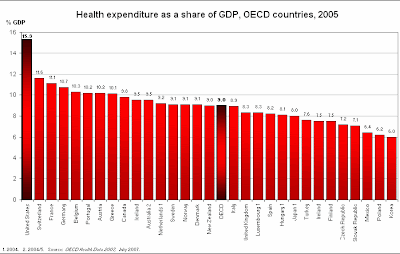
Our Government Spends Less Per Capita on Health care Than Any Other Nation
(In other words, we each pay more of the bill than citizens in other countries do)

We Have Poorer Health Care Outcomes Than 36 Other Countries

To be Continued....
We spend more of our national gross domestic product on health care than any other nation in the world.

Our Government Spends Less Per Capita on Health care Than Any Other Nation
(In other words, we each pay more of the bill than citizens in other countries do)

We Have Poorer Health Care Outcomes Than 36 Other Countries

To be Continued....
Tuesday, February 24, 2009
Thomas Jefferson on Banking Swindlers
"Everything predicted by the enemies of banks, in the beginning, is now coming to pass. We are to be ruined now by the deluge of bank paper. It is cruel that such revolutions in private fortunes should be at the mercy of avaricious adventurers, who, instead of employing their capital, if any they have, in manufactures, commerce, and other useful pursuits, make it an instrument to burden all the interchanges of property with their swindling profits, profits which are the price of no useful industry of theirs." --Thomas Jefferson to Thomas Cooper, 1814. ME 14:61
=
"I sincerely believe... that banking establishments are more dangerous than standing armies, and that the principle of spending money to be paid by posterity under the name of funding is but swindling futurity on a large scale." --Thomas Jefferson to John Taylor, 1816. ME 15:23
=
"I sincerely believe... that banking establishments are more dangerous than standing armies, and that the principle of spending money to be paid by posterity under the name of funding is but swindling futurity on a large scale." --Thomas Jefferson to John Taylor, 1816. ME 15:23
Subscribe to:
Posts (Atom)